
'Write If You Will...' - Critical Reflections on Visual Insurrections

For the last year, I’ve been working on an essay project focused on photography and the African American experience. Inspired by the events of 2020 as a watershed year in history, my experiences engaging with social media posts on Instagram in addition to teaching a unit on visual rhetoric in a first-year writing course, culminated in a photo essay analyzing some protest visuals from Gordon Parks and Devin Allen.
One of the things that struck me as I was doom scrolling on Instagram one May 2020 night-morning during the civil unrest taking place across the nation was how people were sharing montages of pictures with songs and speeches in the background. The photos in some of the posts juxtaposed black and white photos from demonstrations in Birmingham in 1963 and Detroit in 1967 and various cities during the responses in 1968 to King’s assassination to the images in 2014’s Ferguson, 2015’s Baltimore, 2016 demonstrations in Chicago and Dallas, and scenes from 2020 Uprising for Black Lives in Minneapolis and Atlanta and countless locales.
What populated some of the IG multi-slide posts on my timeline were audio clips of James Baldwin describing how the American dream comes at the expense of Black folks in his 1965’s Cambridge debate with William Buckley. There were also posts containing text excerpts of Audre Lorde’s “The Master’s Tools Will Not Dismantle the Master’s House,” and some of Malcolm X’s fiery oratory from the Black ballrooms of Detroit and community cyphers in Cleveland. Although the seriousness of the clips hit home, humor and sarcasm also took center stage to help lighten the mood. Standup bits about race relations from Dick Gregory, Chris Rock, and Dave Chappelle emerged to critique the status-quo. Other clips engaged quintessential Black figures as freedom fighters against whiteness and oppression. For instance, videos of Muhammad Ali’s anti-war diatribe and pieces of Toni Morrison’s interviews were among the shared, liked, and profusely commented on. The genius to be both on time and timely is a testament to the power and intellect of Black people. To be memory gatherer and storyteller on a real-time mobile app like Instagram and Twitter is tantamount to our culture as we remix the function of the West African griot to engage in the Sankofa tradition of retrieval or “to seek and take with you.” This archival and curation work in times of rage and resistance proves to be foundational in cataloging moments of resilience and response for our collective transformation.
During all this meaning-making, I was reminded of Lorraine Hansberry’s very searing, but introspective question of sacrifice in To Be Young, Gifted, and Black, where she says:
Do I remain a revolutionary? Intellectually — without a doubt. But am I prepared to give my body to the struggle or even my comforts? This is what I puzzle about. (249)
For Sweet Lorraine, the conundrum she faced was speaking out about, for, and in service to her people and risk losing her possessions and some privileges she gained as an award-winning, heralded playwright. As she continued to champion civil rights, this revolutionary fight came at a great personal cost, which ultimately piled anguish and anxiety on her rapidly deteriorating body. She eventually lost the fight to pancreatic cancer at the tender age of 34. But her work in re-imagining freedom for Black Americans and the diaspora with her voice and artistry remains an incredible literary testament and provides a learning experience for Black and non-Black students in secondary and postsecondary education.
At 33, I’m re-evaluating how I can use my body and functioning brain to continue the fight for imagined freedom as others before me have. Folks have given their lives up for the abolition of slavery, the Struggle for Civil Rights, and countless other demonstrations across time and space for Black lives to matter. I will concede—much like Lorraine—I’m not ready to give up some of the spoils and privileges I have earned and worked hard for. I’ll say here that COVID had me examining my social contracts like never before. In the wee hours of the morning looking at the undecorated walls of my one-bedroom apartment, I would ask myself, “Do I enjoy my home? Do I like my job? Do I like the people I’ve created community with? Have I done enough to be fulfilled? Am I doing what’s necessary to fill my cup?” These questions, along with my bubbling anxiety of accomplishing my fiduciary responsibility at my gig, helped guide me in a way where I needed to use this unbridled energy for something bigger than myself.
So, in line with Ms. Hansberry, I feel like my intellectual work serves folks far better more than my body might. My penchant for educating others also outweighed my inclination to talk and testify on my personal experiences and put my body on the line for the work. So, I was mobilized to empower my students through leaning into professing. Because I aim to get my classroom to function dialogically through conversation and writing activities, I hoped that my role as a professor would ultimately push my students to consider how their work responded to this moment of civil unrest; and, selfishly, I hoped I’d be able to see myself in their work and gain confidence in my own writing. Problem was, the classroom I was brought up in no longer existed, so I had to find ways to teach composition and empower all while fighting through different degrees of separation. When I really sit back and think about that time, I think it was watching one of my brothers fall in love with a new artistic expression that made me take my own art more seriously.
My brother JonLeo always had a gift for stopping time. When the homies would kick it in HQ and Rick Ross, Dot, Wale, Kanye, Jay, or the college hits from the time would fill the Thirsty Thursday kickback background, he would capture moments that we’d forget about until the next morning. Other times, when we did our civic duty at our Home by the Sea, he’d take his iPhone out and snap a flick. Sometimes, he’d showcase the sun’s glare on the principal subject matter to give an impression of spirituality and ascension. Other times he’d use shadows to bring out the hidden elements of a portrait’s story for dramatic effect. On occasion, he’d use misdirection to give deep composition to his work. But most times, he’d use his vantage points to illustrate the surrealism of the environment.
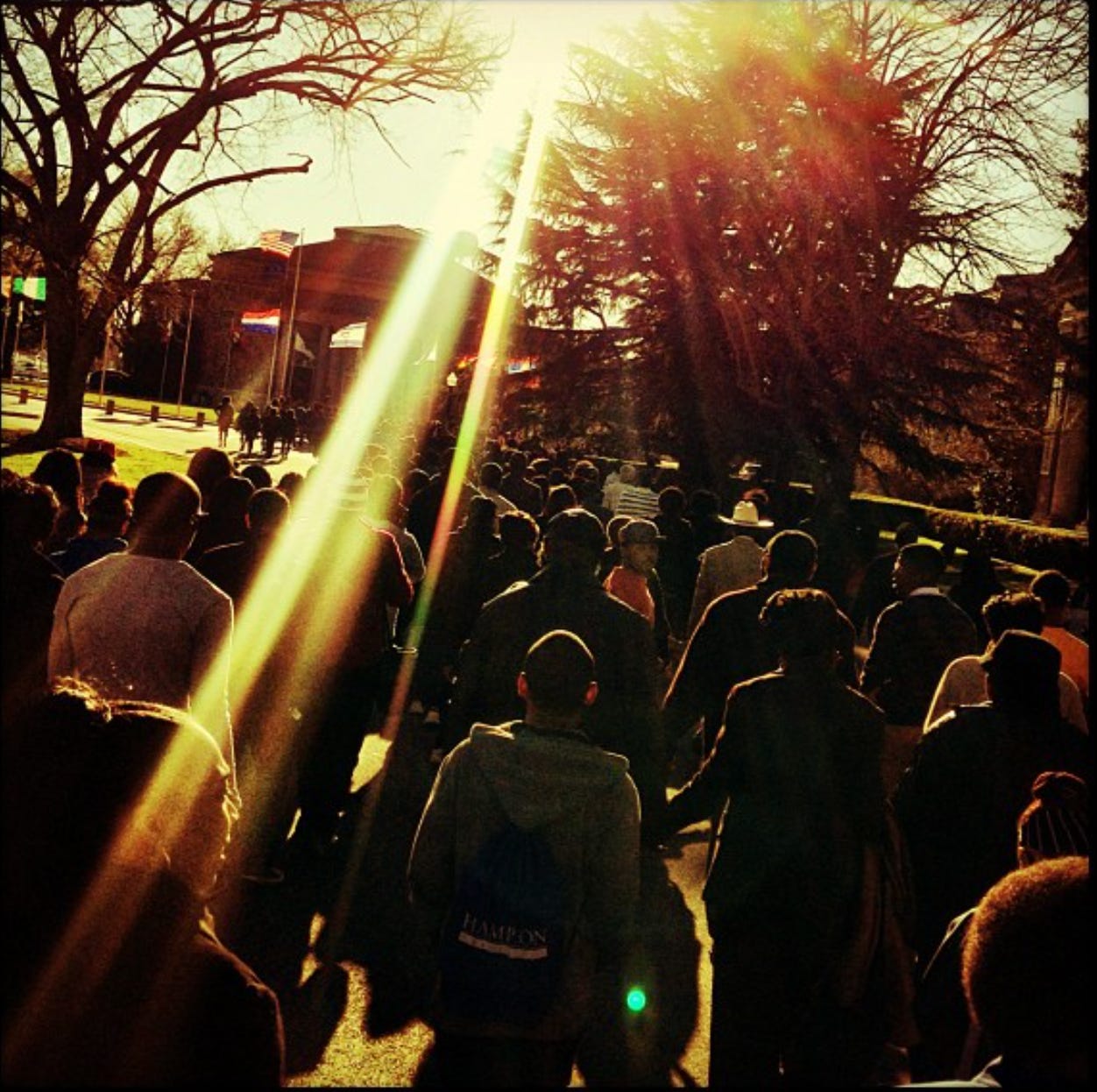
For years, he masqueraded as a natural science major until he found his way in education. Even after graduating, he leaned heavily upon what he knew about educating the youth; but much like Gordon Parks and Devin Allen, he always had a keen eye for using his art to showcase the rich vibrancy of our people. It wasn’t until the pandemic where he was forced to lay down his pencil and whistle and picked up a Sony Alpha camera to lay his testimony bare. To his credit, he was finally leaning into his superpower that he buried behind responsibility. His passion for artistic expression laid dormant until he was able to finally able to convince himself that the camera was his weapon of choice. Since he made that choice, he’s fearlessly attacked the expression of photography with unwavering fervor, garnering placement in magazine pictorials and advertisements. All he needed was a moment to carry him to the promised land. What we didn’t know was the moment that pushed all of us would ultimately be the moment that pushed Americans to the brink of despair and into civil disobedience.
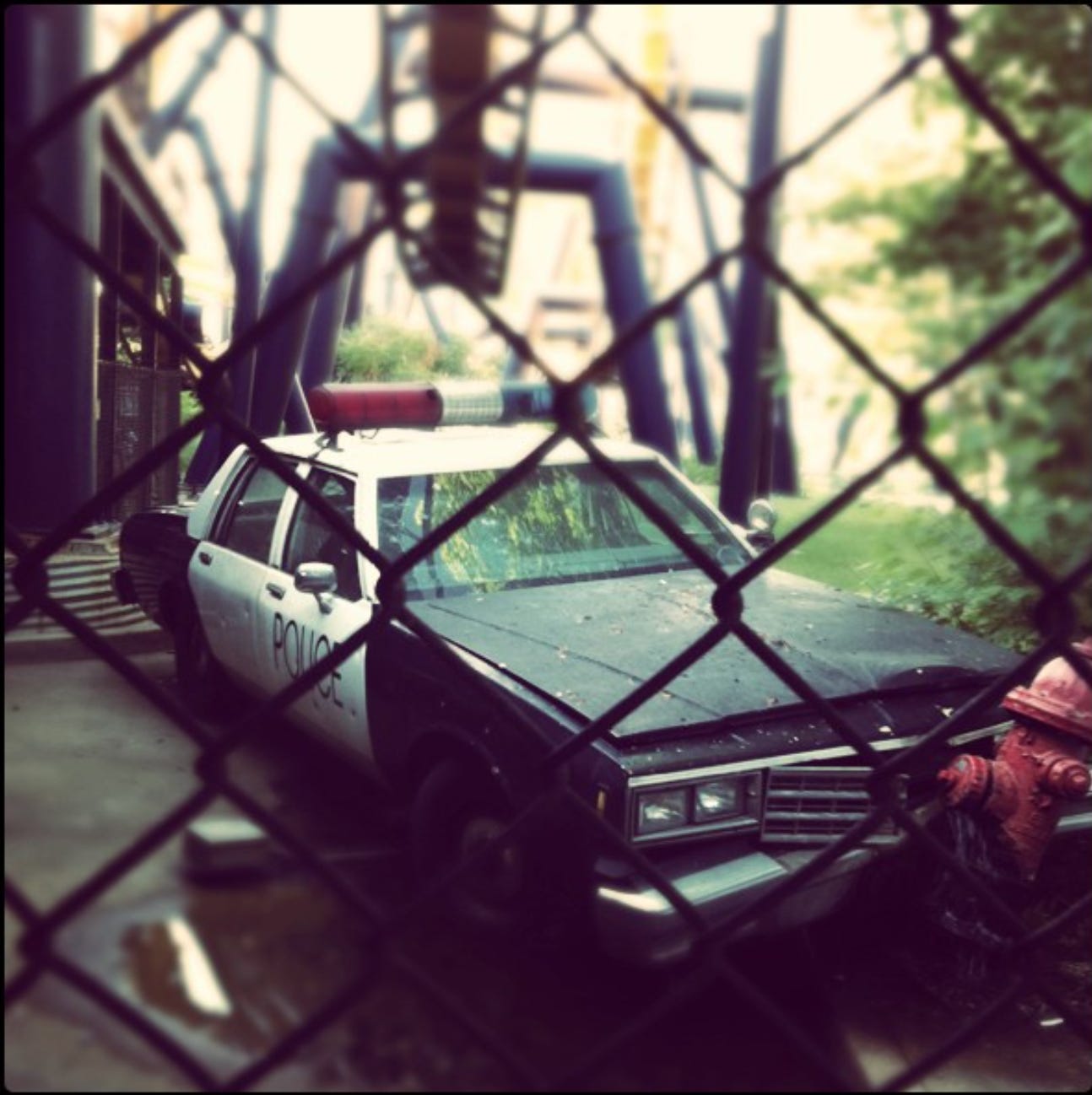
At the end of his politically charged comedic statement, 8:46, Dave Chappelle emphatically states:
These streets will speak whether I’m alive or dead. … We’ll keep this space open. This is last stronghold for civil discourse. After this shit, it’s just rat-tit-tat-tat-tat-tat-tat-tat-TAT! (26:30)
What I believe Dave was referring to as “this” was the streets where the real work of civil discourse is enacted. The street, as a counter-public space, is rife with kinetic energy that allows cyphers to do the work of responding and healing and testifying in real time. And because we all were responding to the death of George Floyd and others like Breonna Taylor, and Ahmaud Arbery, these 2020 streets were filled with a coalition of folks that Fred Hampton dreamed of having in 1968 Chicago. So, my brother felt he should start documenting these people, our people. He wanted to help provide some depth to the visual discourse being disseminated around social media platforms. More important, he wanted to raise his critical awareness and use his ardent photographic eye for a broader and bigger purpose, which was to highlight the vibrant and complex lives of Black people living in urban communities. As a native Chicagoan, he shed light on the city’s inhabitants and captured their testimonies in the best way he could.
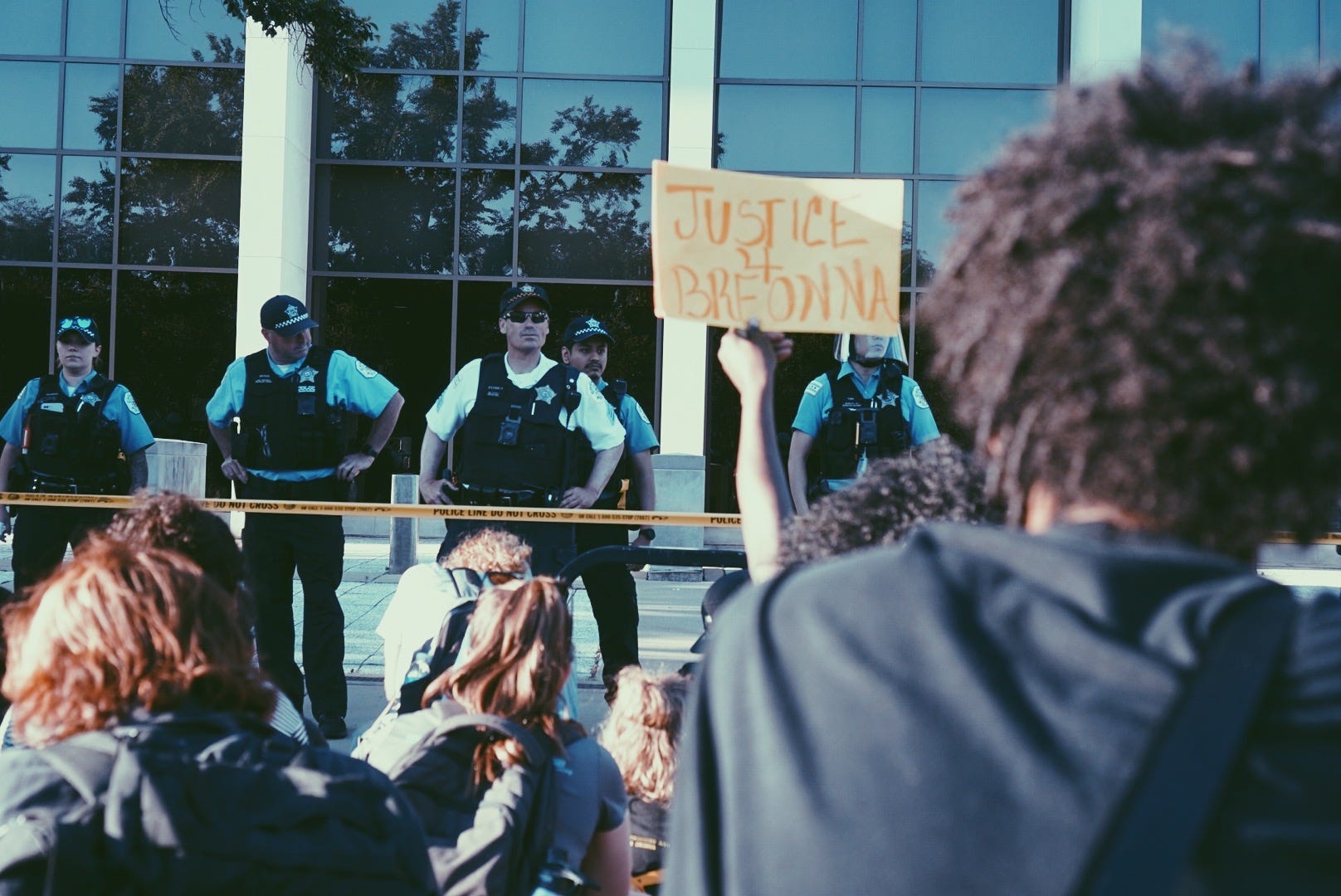
For instance, this standoff between citizen-activists and Chicago’s “Finest” features an assembly line of cops separated by yellow tape and bike barriers. The concrete they stand on is the only sturdy foundation folks can use as a resting place. As Tricia Hersey notes, “rest is resistance.” The coalition captured in the photo takes a Kaepernick-style knee while James Cameron’s T-1000 from 1991’s Judgment Day looks on with a stern face. Affixed with a body cam, hat, and shades, the summer weather has him looking more like Top Gun rather than SWAT. His brothers and sisters in blue flank him on each side while the human subjects in front of them are kneeling or sitting. While most of the lens’s focus is on the left and middle thirds of the photo, the real subject of the photo is the “Justice 4 Breonna” poster that’s vibrant, but slightly obscured by the shadow and aperture. While JonLeo suggested that “this was a mistake and he wished the poster was more in focus;” as an observer, I felt that this “blunder” was intentional especially given how the world – and the two warring parties in the picture’s composition – views Black women. I thought that the picture, specifically with the shade looming over the bright, but erasured text on the poster was symbolic of the way Black women have been (mis)treated, ignored, and exiled; and because of patriarchy, racism and sexism, and misogynoir, their bodies, rights, and ideals have been rendered invisible to the American public.


JonLeo’s street photography work eventually morphed into portraiture photography, but that ever-present eye still centers Black people in the midst of love, pain, joy, and angst as we navigate through this nihilistic American society. His attention to detail and willingness to use his senses and techniques to engage a critical eye serves an inspiration for folks who view his art. And I believe that’s what inspired me to bring this level of nuance to my students in the Fall.
In the words of Charles Dickens and Oskar from Nickelodeon’s Hey Arnold, Fall 2020 semester “was the best of times, [and] it was the worst of times.” I was so stretched taking on multiple projects to make my ends meet. I was grateful and thankful to have a few opportunities fall into my lap, while some of my friends were laid off from their respective organizations. We were in a time where social contracts were getting renewed, and everybody was evaluating their place in the world. While life was life’n, capitalistic institutions were trying to figure out what was “essential,” and the “commander-in-chief” was trying to figure out how to put his name on stimulus checks to garner more votes for November. Here I was trying to arm myself with the mental fortitude of teaching 80 students virtually, and I get thrown a last-minute curveball to teach honors freshmen composition in an unorthodox fashion.
Armed with meditation, music, and small units on multimodal writing, critical literacy, and discourse formation, I walked 18 students through a few Black scholars and their ideas about engaging the environment with language and composition varieties in a 13-week course. What came out of those three-hour Saturday sessions was a passion for social justice and an incessant desire to capture and catalog their writings for transformative purposes. Our second unit, the Visual Rhetoric module, tasked students to read David Kirkland’s 2009 essay “The Skin We Ink,” where he discusses how young men use tattoos to inscribe and transcribe cultural memories on their bodies. The testimonies one carries on their body to memorialize, immortalize, and archive people and stories of their culture is a representation of the critical literacies and writing practices of a community. The students used this unit project to conceptualize a photo essay that responded to an integral issue in their community. In other words, they had to create an project that used a combination of words, images, and other forms of media that addressed a cultural problem or challenge. Their projects ranged from discussing issues of cultural appropriation of Black hair styles, colorism and racism in 20th century depictions of Asian artistry, shadows of Confederate ideology in predominantly Black communities in the south, media (mis)representations of Black manhood, and so much more. I was, and still am so proud of what these students accomplished especially considering the number of obstacles we faced throughout the semester. Much like my other freshman and upperclassmen writing courses from that semester, these honors freshmen were incredibly confident in their work, vulnerable in their class offerings, and more important, they were receptive to the ideas and concepts we discussed ad nauseam in our class lectures. Shoutout to those students in those class that recently walked across that stage as the Class of 2024.
Lorraine came back to me in my dreams after one humid Spring night of tossing and turning. I woke up in a cold sweat and heard whispers of her smooth, ethereal voice in my stupor. (LOL, maybe it was Anika Noni Rose) She said:
Write if you will; but write about the world as you think it ought to be and must be – if there is to be a world.
I thought deeply about what I did with the students that fall. But her statement made me internalize that I was young, gifted, and Black. That visual essay unit led me to dive headfirst back into creative writing and writing for a purpose. My goal was to write a publishable paper for an academic journal or a creative nonfiction outlet. While I thought I’d discuss my experience in teaching the class during COVID, my project eventually morphed into a photo essay that I envisioned during those sleepless nights scrolling through Instagram.
Iterations of my photo essay took shape during the 2021-2022 academic year. I was still hype over the class and still fixated on the idea of being a writer-journalist on all the visuals (both photo and video) being passed around on social media. But what really helped was setting a small goal of presenting at a conference. If I could get some text on the page and walk folks through a set of photos that I discussed creatively and within the tradition of African American literature, I’d be super smooth. The 2023 College Language Association conference was focused on “Rage, Resilience, and Response” as linchpin for literary and cultural movements in African American and African diasporic traditions. My paper was tied to a panel on liberation memories and emancipatory narratives fashioned under the thought processes of Cheryl Wall’s work on the art form of the African American essay in her 2018 work, On Freedom and The Will to Adorn. At first, I thought I’d work out a narrative prose form of the essay for the conference’s audience who would come and see the panel presentation; however, I pivoted to discuss how Gordon Parks’ and Devin Allen’s photography acts as a conduit for enhancing our reads of literature and discourse. This project, “These Streets Will Speak Whether I’m Alive or Dead: Photography and Vernacular Visual Essays in a Time of Chaos,” spoke about a rhetorical technique that Parks and Allen use in their work as a source of inspiration and archival method for stories of resistance and protest.
After the conference, I was exposed and blessed with an opportunity to take part in an Introduction to Digital Humanities (DH) institute. This institute – geared towards graduate students, junior and senior faculty in the humanities – was extremely helpful in introducing me to DH tools and techniques to visualize and remix a research project. For me, digital humanities is a communal practice and process that uses tools of analysis, cataloguing and archiving resources, and mapping techniques for projects that produce radical and transformational knowledge in discourse. The space cultivated by University of Kansas’s History of Black Writing program and Dr. Maryemma Graham and Dr. Amy Earhart was integral for me in learning how to apply these methods onto personal passion projects and teaching philosophies. While the project was still in the conference paper stage from CLA, I wanted to take it a step further and connect the captured moments to the larger canon of the African American Expressive Tradition.
What I ultimately set out to create with my DH project was an online exhibition to share my photo essay with general audiences. While some of the workshops highlighted Storymaps or Timeline as storytelling tools, I was enamored with Scalar’s blogging capabilities especially since it felt like an easy transition from old days using Wordpress or Blogger. I also did some research and hoped that Pitcha (as a photojournalism tool) still existed; once I realized that it was no longer supported, I was reminded of a scholar’s warnings of “link rot” and “content drift” (technical digital humanities terms that promotes a project’s forced obsolescence). So, I decided to use Scalar as an exhibition tool for my photo essay project. Initially, I wanted to showcase the images in a scrolling marquee and have the photo’s commentary pop up as one takes in the image, but the software is a bit antiquated, so I provided the photos in-line with the text and in a gallery showcase above the analyses. I also edited the introduction to provide more context and lyrical prose to the essay to make it feel more personable, creative, and introspective. The title was also changed to be more concise and less technical so that it didn’t feel daunting to prospective readers. The final project, Protest Portraits: Black Resistance Stories Through the Lens, was a labor of love and I’m proud of the work I was able to create. Please feel free to read and react at your own leisure.
Eventually, I want my project to include more photos from other photographers, like Cecil Williams, JonLeo, and others who have done this work of capturing the work of civil rights and unrest in modern and contemporary contexts. I think their work suggests how far the method of vernacular transcription stretches across the canon(s) of the African American photography, literary, and expressive traditions. One of the things I’d like to do with this project is to gain permission from the Gordon Park Foundation to use Parks’ and Allen’s photographs in perpetuity. I think being able to illustrate the importance of the connections drawn from visual culture and literary symbols can be helpful to enhance how we read, respond, and catalogue the knowledge centers of our culture.
While Scalar is a cool first step to hosting this as an exhibition, the ultimate goal is to showcase the exhibition as a larger project in a six-month to year-long installation at the Arthur Schomburg Center of Research in Black Culture or as an online project exhibition with the Gordon Parks Foundation. I think finding a synergy between library and research services and academic research can be a healthy collaboration for people to engage with. For students, laypeople, and folks who have a general interest, I think it would be an incredible learning experience that will allow people to learn more about the Black American visual culture and an provide an immersive essay reading and storytelling experience.
This journey of photo-essaying and meaning making has been an arduous undertaking. I’ve learned to be both incredibly patient and painfully curious especially considering the multilayered, nuanced materiality of photography and archiving stories. Part of my research in graduate school clarified how the current, sometimes playful use of digital artifacts can be detrimental to our understanding of literature, but what I think is extremely important here is the necessary work these social media reels, memes, and videos do to connect, conceptualize, and inform audiences of all walks of life. And to document and analyze this work is the important work for the scholar as they make sense of the world they inhabit.
That was really my goal from the jump with the students, with my audience for my project, and for me. I needed to make sense of the chaotic world I was living in. Paraphrasing Chappelle here, “these [photos] will speak whether I’m alive or dead … this is the last stronghold of civil discourse. After this shit, it’s just… rat-tit-tat-tat-tat-tat-tat-tat-TAT!” Rather than gunshots in the public sphere, I hope that it’s the sound of a camera capturing memories or meaningful fingers on the keyboard that echo in the distance.